Last updated October 15, 2026
ADU Warning Signs: A Pasadena Homeowner’s Reference Guide
A diagonal crack at the corner of a window opening is not the same as a horizontal crack at the base of a stem wall. One is almost always cosmetic. The other is a structural red flag that can mean the difference between a $400 drywall patch and a $40,000 foundation repair. Most homeowner guides describe both as “cracks to watch” and leave it there. For more guides & resources, see our blog. This guide does not. It names the specific visible indicators that something is wrong with an ADU’s structure, envelope, electrical system, or permit status in Pasadena, and tells you what each one actually means when you find it.
Quick Answer
ADU warning signs fall into four categories: cracks that indicate foundation or framing movement, moisture patterns that indicate water intrusion, electrical symptoms that indicate sub-panel or wiring deficiencies, and permit-status gaps that indicate the structure was never properly finaled. A diagonal crack wider than 1/4 inch at a door or window corner, white chalky residue on block walls, warm outlet cover plates, and missing final inspection records are all signs that warrant immediate professional attention in Pasadena. If you are deciding whether to tackle issues yourself or bring in a pro, read DIY vs Professional ADU: The Pasadena Homeowner’s Decision Guide.
Table of Contents
- Crack Taxonomy: Which Cracks Matter and Which Ones Don’t
- Moisture Warning Signs Specific to Pasadena ADUs
- Electrical and Sub-Panel Warning Signs in ADU Conversions
- How to Identify an Unpermitted ADU That Was Never Finaled
- Warning Signs in Contractor Behavior During an Active Build
- Foundation Movement: What Pasadena Soil Does to ADU Foundations
- Common Mistakes to Avoid
- When to Call a Professional
- Frequently Asked Questions
- The Bottom Line
Crack Taxonomy: Which Cracks Matter and Which Ones Don’t
Not every crack is a problem. In Pasadena, where houses sit on anything from decomposed granite to alluvial fan deposits, cracks appear for reasons that have nothing to do with structural failure: lumber drying, stucco curing, minor settlement in the first two years after construction. The skill is knowing which ones to ignore and which ones to have looked at by a licensed structural engineer.
Cracks You Can Usually Ignore
- Hairline cracks under 1/16 inch. These are almost always cosmetic, caused by normal expansion and contraction. They appear in drywall and stucco, run in any direction, and do not grow over time.
- Vertical cracks at drywall seams. When the paper tape separates from the joint compound, it is a finish issue, not a structural one. A drywall contractor can fix it in an afternoon.
- Shrinkage cracks in garage slabs or walkways. Concrete shrinks as it cures. If the crack is narrow, has no vertical displacement, and does not widen, it is not a foundation problem. The Garage Conversion Contractor in Pasadena work we do regularly surfaces these on existing slabs.
Cracks That Require a Structural Engineer’s Eyes
- Diagonal cracks at window or door corners larger than 1/4 inch. These indicate uneven settlement or shear stress. The corner of an opening is where stress concentrates. When the crack is wide enough to fit a pencil tip, the load path has been compromised.
- Horizontal cracks in stem walls or foundation walls. Horizontal means lateral pressure. In Pasadena, expansive clay soils push against foundation walls seasonally. A horizontal crack in a stem wall below grade is a serious finding.
- Stair-step cracks in masonry or stucco that follow mortar joints. This pattern means the wall is moving as a unit, not just cracking at a stress point. It typically indicates differential settlement: one section of the foundation is dropping faster than the one next to it.
- Gaps between the ADU and an attached garage or house. If a garage conversion or attached ADU is pulling away from the main structure at the shared wall, the separation indicates the two buildings are moving independently, which should not happen after proper foundation tying.
In our experience, diagonal cracks wider than 1/4 inch at opening corners are the single most common structural finding we see in Pasadena ADUs built before the 2020 ADU ordinance update. Many of those early ADUs were permitted as garage conversions with shallow footings that were never engineered for a dwelling unit’s live load.
Reed Calloway, who leads our team, has walked enough Pasadena backyards to recognize the difference between a cosmetic shrinkage crack and a shear failure before he gets within ten feet of the wall. Most homeowners can learn to do the same with a straightedge, a pencil, and a few months of observation.
Moisture Warning Signs Specific to Pasadena ADUs
Pasadena gets about 20 inches of rain in an average year, almost all of it between November and March. That concentrated wet season means water intrusion problems announce themselves in a predictable pattern: the first heavy rain reveals every flashing, grading, and drainage defect that the dry months hid. Reading the signs correctly requires knowing where water actually comes from when it shows up inside an ADU.
Efflorescence on Block Walls or Concrete Stem Walls
Efflorescence is the white, chalky, powdery residue that forms on masonry when water moves through it and leaves dissolved salts behind as it evaporates. It looks harmless. It is not. Efflorescence on an ADU’s stem wall means water is migrating through the concrete or block from the exterior side. The source is usually one of three things: negative drainage against the foundation, a missing or failed damp-proofing coating, or a leaking irrigation line running parallel to the wall.
In Pasadena, where many ADUs are built against the uphill side of a sloped lot, negative drainage is the most common culprit. Water sheets down the yard during winter storms, collects against the stem wall, and hydrostatic pressure drives it through. If you see efflorescence on the interior face of a below-grade wall, the water source is exterior. Fixing the paint over it does nothing.
Staining Patterns Below Window Sills
Brown or rust-colored staining on drywall directly below a window sill indicates water is entering at the window opening and running down inside the wall cavity. The window itself may be dry to the touch. The leak is often at the sill pan flashing, the head flashing, or the installation gap between the window frame and the rough opening.
ADUs built with prefab panel systems are not immune. Even with factory-built wall assemblies from ADU Builders in Pasadena we work with like Boxabl or Plant Prefab, site-installed window flashing is a field operation. A poorly lapped piece of flashing tape at the sill corner is all it takes. On conventional builds using James Hardie siding, the culprit is frequently a missing Z-flashing above window trim or improperly lapped housewrap.
Musty Odor in an ADU with No Visible Stains
Smell is a warning sign. If an ADU has a persistent musty or earthy odor, especially after rain, there is hidden water somewhere in the assembly. Common locations: the rim joist area behind the kitchen, the wall cavity beneath a leaking supply line, or the subfloor in a garage conversion where the original slab had no vapor barrier. Trust the nose. By the time stains appear on finished surfaces, rot has often been progressing for months.
Electrical and Sub-Panel Warning Signs in ADU Conversions
Electrical problems in ADUs rarely announce themselves with a bang. They whisper: a warm cover plate, a breaker that trips occasionally, a light that flickers when the mini-split cycles on. Each symptom points to a specific class of problem, and knowing the difference matters because the fix ranges from a $150 service call to a full sub-panel replacement.
Warm Cover Plates on Outlets or Switches
A cover plate that is warm to the touch during normal use is never normal. Warmth means resistance, and resistance means heat generation inside the box. The most common cause in ADU conversions is a loose termination: the wire is not fully seated under the device screw, creating a high-resistance connection that heats under load. The fix is simple when caught early: tighten or re-terminate the connection. Left alone, a loose termination can arc, melt the insulation, and start a fire inside the wall.
Breakers That Trip Under Normal Load
If a breaker trips when you run the microwave and the toaster at the same time, the circuit is overloaded. If it trips when you run only the microwave, something else is wrong: a ground fault, a short, or an undersized circuit that was never designed for a dwelling unit’s load. In garage conversions, we frequently find the original garage circuit was 15 amps with 14-gauge wire, which is fine for a garage door opener and a work light, but not for a kitchenette with a refrigerator, microwave, and countertop appliances.
The real test: a properly designed ADU sub-panel should have dedicated circuits for the mini-split heat pump, the water heater (if electric), the kitchen small-appliance circuits, and the laundry. If everything in the ADU runs on two or three breakers, the electrical system was never upgraded for dwelling-unit use, regardless of what the permit says.
Improper Double-Tapping in the Sub-Panel
Double-tapping means two conductors are terminated under a single breaker screw that was designed for one. It is a code violation in nearly every case. Homeowners can check this themselves: open the sub-panel cover and look at the breakers. If any breaker has two wires under one screw and the breaker is not specifically listed and labeled for two conductors, the panel needs correction. This is a warning sign that whoever wired the ADU cut a corner, which means there are probably other corners you cannot see.
Flickering Lights When a Motor Load Cycles
When the mini-split compressor or a washing machine motor starts and the lights dip or flicker for a second, the feeder to the sub-panel may be undersized. In Pasadena ADUs, this shows up most often in structures fed from the main panel by a long underground run. Voltage drop across an undersized feeder gets worse the longer the run is. If the lights flicker in a detached ADU that sits 80 feet from the main panel, the feeder was likely sized with no allowance for distance. A licensed electrician can measure the actual voltage sag and correct the feeder if needed.
The electrical differential is the thing to remember: symptoms that appear only when a motor load starts point to feeder or circuit undersizing. Symptoms that appear during normal resistive loads point to connection quality. Both are fixable, but the fixes are entirely different and the costs are not close.
How to Identify an Unpermitted ADU That Was Never Finaled
An unpermitted ADU is a structure that was built without the city’s approval. An unfinaled ADU is a structure that was permitted but never passed its final inspection. Both create legal exposure for the property owner, and both leave specific paper and physical traces that a homeowner can identify before buying, renting, or financing.
Paper Trail: What to Look for at City Hall
The Pasadena Department of Building and Safety maintains permit records for every address in the city. A homeowner can request the permit history for their property in person or online through the city’s permit portal. The records to check:
- Was a permit ever issued for the ADU? If no permit exists and the structure was built after the date the property’s original construction permits closed, the ADU is unpermitted. This is the simplest check and the one most skipped.
- Was the permit ever finaled? A permit that was issued but never finaled means the structure was inspected during construction but never passed the final inspection. The permit sits open, sometimes for years. In Pasadena, open permits are a standard disclosure item in real estate transactions, but cash transactions on family properties can bypass disclosure entirely.
- What does the final inspection record say? If the record shows final approval for electrical, plumbing, and building, the ADU is legal. If it shows partial finals with unresolved corrections, the ADU is not.
The presence of a water heater, a kitchen sink, and a cooking appliance inside a converted garage is itself a warning sign when the permit record describes the structure as a “storage room” or “workshop.” The description on the permit is the city’s official understanding of what was built. If the actual use does not match the permit description, the structure is out of compliance regardless of what the walls look like.
Physical Traces of an Unpermitted Conversion
Unpermitted garage conversions often leave visible evidence of their history: original garage door rails still mounted inside the ceiling, a slab floor that slopes toward the former door opening, a step-up threshold where the garage door was infilled with a wall, and an electrical panel that still shows the original garage circuit labeling. None of these alone proves a conversion was unpermitted, but together they suggest the structure was converted from a garage to a dwelling without the city’s knowledge.
Why It Matters for Buyers and Renters Both
A buyer who purchases a property with an unpermitted ADU inherits the violation. When the sale is financed, the lender may require the ADU to be permitted and finaled before closing, which stalls the deal. When the sale is cash, no lender checks anything, and the violation passes silently to the new owner. The new owner then discovers the problem when they file for a renovation permit on the main house and the city flags the unpermitted structure in the same parcel record.
A renter living in an unpermitted ADU faces a different exposure: the city can order the unit vacated if code enforcement becomes involved, which happens most often after a neighbor complaint or a utility irregularity. The tenant loses their housing with short notice, and the owner loses the rental income plus the cost of legalizing or demolishing the unit.
For homeowners in Pasadena considering an ADU purchase or a garage conversion, the Fielding ADU Pasadena home team can review the permit record and tell you plainly whether a structure is legal, legalizable, or a problem before you buy.
Warning Signs in Contractor Behavior During an Active Build
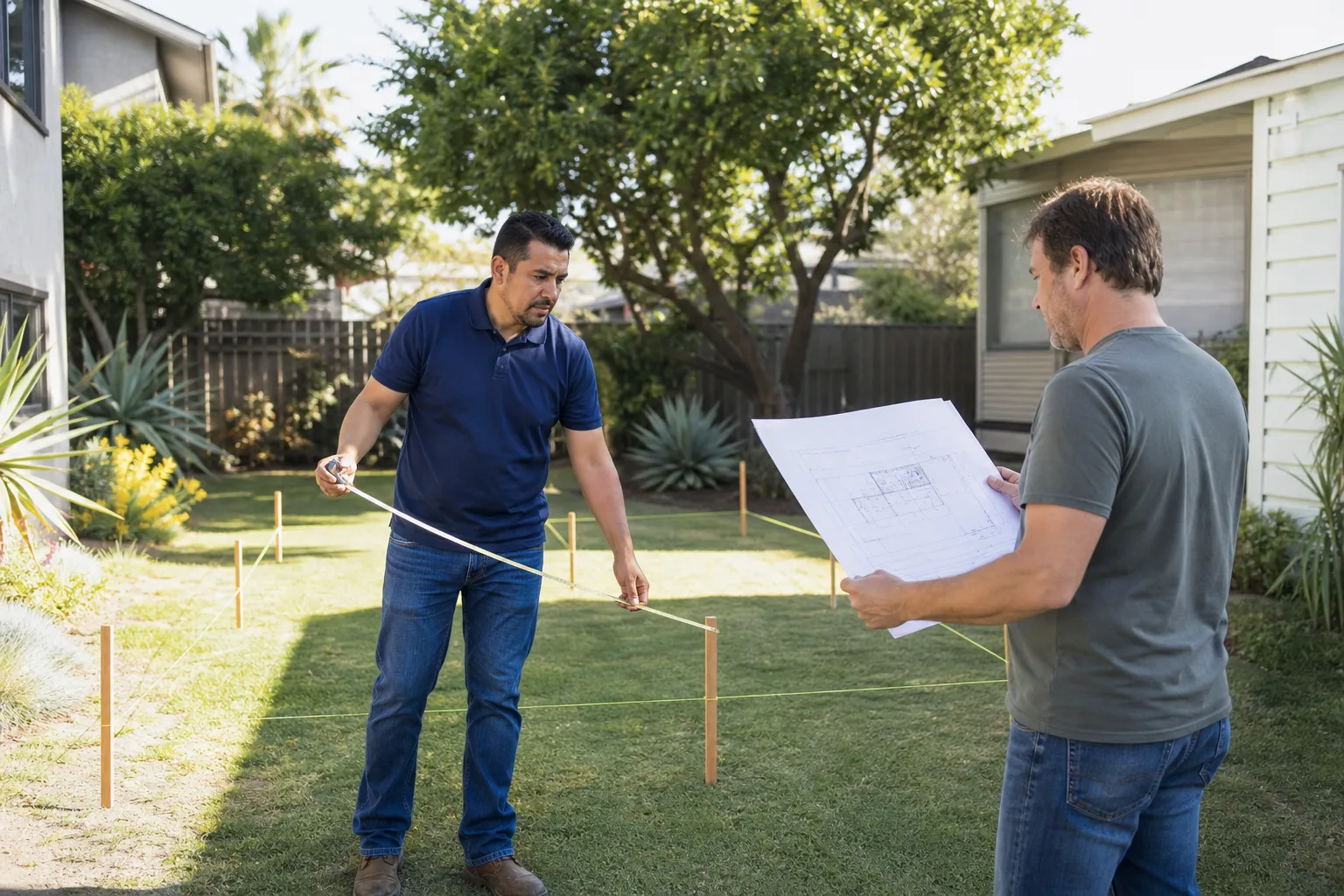
Some of the most expensive ADU problems in Pasadena happen before the structure is ever finished. They happen during the build, when a contractor deviates from the permitted plans and the homeowner does not know how to read the change. Knowing what a permitted plan requires and what an unpermitted change looks like on the ground is the difference between a smooth project and a stop-work order.
Deviations That Show Up Early
- Foundation work that does not match the plan’s depth, width, or reinforcement schedule. The foundation is the hardest thing to inspect after the fact because it gets covered in concrete. If the trench does not match the plan’s dimensions at the time of the pour, say something the same day. Once the concrete sets, the evidence is buried. A contractor who shortens a footing or omits a dowel is converting an engineered foundation into a guess.
- Framing lumber sizes that do not match the plan’s schedule. If the plans call for 2×6 exterior studs at 16 inches on center and the walls are framed with 2x4s at 24, that is a load-path change. It is not an upgrade. It is a downgrade made to save material cost, and it changes the structural capacity of the wall.
- Electrical rough-in that does not match the panel schedule. The permitted plans show circuit counts, outlet locations, and wire sizing. If the rough-in shows fewer home runs than the plan calls for, circuits are being combined to save wire and time. This is the type of change that passes a visual inspection but degrades the system over its life.
- Windows or doors substituted for smaller units. The plan calls for egress-sized windows in sleeping rooms. If the installed window is smaller than the plan’s callout, the sleeping room is no longer code-compliant. Egress requirements are life-safety requirements. This substitution is non-negotiable.
When to Stop a Job and Call the City
When a deviation is structural, electrical, or life-safety related, the homeowner has the right to stop the job and contact the Pasadena Building Department for an inspection. The sequence: document the deviation with photographs, request the contractor hold work on the affected scope, and call the building department to request an inspection of the discrepancy. The city’s inspector will compare the field condition to the stamped plans and issue a correction notice if the work does not match.
The Garrison Standard, which Fielding ADU Pasadena operates under, is built on the opposite approach: the price goes in writing before any work starts, the permitted plans are the contract, and any change that affects the plans goes through the city before it goes through the framing. Reed Calloway runs every Fielding project through the Garrison Code: show up in the window, price in writing, by the book, leave it clean, stand behind it for a year. No deviations, no verbal changes, no handshake substitutions.
A contractor who gets defensive about plan compliance is a contractor who has deviated from plans before. A contractor who invites the inspector to look is a contractor who built to the plan. Watch how the contractor reacts to the question and you will learn more than the answer itself would tell you.
Foundation Movement: What Pasadena Soil Does to ADU Foundations
Pasadena sits on a geologically varied patchwork. Some neighborhoods sit on stable alluvial fans; others sit on expansive clay that swells and shrinks with seasonal moisture. An ADU built on a simple slab in a clay zone behaves differently than the same footprint built on piers in a gravel zone. Homeowners who know their soil type can read foundation cracks with more precision than any generic guide allows.
Expansive clay moves vertically. It swells when wet and shrinks when dry, which means a foundation in a clay pocket rises and falls with the seasons. The movement is slow enough to be invisible day to day but large enough to crack drywall at the corners of openings over a decade. This is why diagonal cracks at door corners in a Pasadena ADU are often seasonal: they open during the dry months and partially close during the wet months. Watch a crack over a full year before concluding it is progressive. A crack that opens and closes with the seasons is settlement accommodation. A crack that widens steadily in one direction is a structural failure in progress.
Sloped lots add another layer. An ADU cut into a hillside has a foundation that holds back soil on one side. If the retaining wall or the uphill foundation wall was not engineered for the soil’s lateral pressure plus the water weight of a saturated slope, the first heavy winter rains can produce a horizontal crack and inward wall movement. This is the failure mode that separates a properly engineered hillside ADU from a garage conversion someone decided to build on a slope with standard footing depths.
For Pasadena homeowners considering a new ADU on a sloped or clay-rich lot, the site evaluation should include a soils report or at minimum a geotechnical review. The extra few thousand dollars in testing is the difference between designing for the soil you actually have and designing for an average soil that may not exist beneath your lot. Our Room Addition Contractor in Pasadena work applies the same rule: the footing design is never assumed, always verified.
Common Mistakes to Avoid
- Ignoring a crack because the ADU “still works.” Structural movement does not care how well the heat pump runs. A crack wider than 1/4 inch at an opening corner is a structural signal regardless of how comfortable the interior is. Waiting costs more than looking.
- Painting over efflorescence and calling it fixed. Painting seals the moisture inside the wall, where it accelerates rot and spalling. The moisture source has to be corrected first. Paint is the last step, not the first.
- Assuming a warm outlet cover is “how it’s always been.” Resistance heating inside an electrical box is never a design condition. It is a defect. The fact that it has existed for months does not make it safe; it makes it a closer call.
- Buying a Pasadena property with an ADU and skipping the permit record pull. The permit pull takes one afternoon and costs nothing. Skipping it can cost a buyer an unfinaled structure that the city later orders corrected or removed. This is the single most expensive mistake in this guide.
- Accepting a contractor’s verbal assurance that a plan deviation is “fine, we do it all the time.” The city is the final authority on plan compliance, not the contractor. If the change is real, get it in writing and get the inspector’s sign-off. If the contractor resists, that is the answer.
- Building an ADU on a sloped lot without a soils review. Hillside lots in Pasadena have lateral soil forces that flat lots do not. A standard footing depth on a hillside is a gamble with a five-figure correction cost when the wall moves.
- Treating all prefab ADU platforms as the same. The factory-built shell from a company like Boxabl or a Tuff Shed-style structure still requires site work, foundation design, utility connections, and permit compliance. The factory does not remove the site’s soil and drainage conditions. The site still determines the foundation, and the foundation still determines the structure’s long-term behavior.
When to Call a Professional
Call a structural engineer when you see a diagonal crack wider than 1/4 inch at a door or window corner, a horizontal crack in any foundation wall, or a stair-step crack pattern that follows mortar joints. These are not cosmetic findings and they do not self-correct.
Call a licensed electrician when you have a warm cover plate, a breaker that trips under ordinary load, or flickering lights that coincide with a motor start. Electrical symptoms are diagnosable and the diagnosis is inexpensive compared to a fire.
Call a general contractor who carries liability insurance and pulls permits when you are planning a garage conversion, room addition, or new ADU in Pasadena. See How to Hire a ADU Contractor in Pasadena: A Step-by-Step Guide for what to look for. If the existing structure shows any of the warning signs in this guide, that contractor should be able to identify the source, quote the correction, and pull the permit to fix it before construction starts. Fielding ADU Pasadena offers free estimates in Pasadena. Call (626) 657-5541 and we will look at the structure, read the permit record, and tell you plainly what you have.
Frequently Asked Questions
Cosmetic crack repair runs $300 to $800 per crack when done properly with epoxy injection. Structural repairs involving underpinning, helical piers, or wall anchors typically run $15,000 to $60,000 depending on the foundation type, the extent of movement, and the soil conditions on the Pasadena lot. The only way to know which category a crack falls into is a structural assessment. Call (626) 657-5541 for a free estimate and we will tell you what we see.
Yes, but the ADU must be disclosed, and most financed buyers will require the ADU to be permitted and finaled before closing. Some cash buyers will accept the property with the unpermitted ADU, but they will discount the price to account for the legalization cost or the risk of city enforcement. The cleanest path is to legalize the ADU before listing. The permit record pull at Pasadena Building and Safety is the first step.
The Garrison Standard promises every project for one full year: if the work fails within that window, Fielding ADU Pasadena returns and corrects it at no charge. That is a written guarantee, not a verbal assurance. It covers workmanship defects in the structure, the envelope, and the systems we installed. The exact coverage is spelled out in writing before the project starts, along with the fixed price.
Neither is automatically better. A prefab structure removes some site labor variables and some weather-related construction risk, but the foundation, utility connections, drainage, and permit process remain site-specific. A poorly installed prefab unit on a bad foundation performs worse than a well-built conventional structure. Fielding ADU Pasadena works with multiple platforms so the method can be matched to the lot, the budget, and the schedule rather than forcing one system onto every site.
Plan on four to nine months from permit application to final inspection, depending on the corrections the city requires and the availability of plan review time. The process starts with a permit record pull, then a site assessment from a contractor who understands Pasadena’s ADU ordinance, then the correction drawings, then the fixes themselves, then final inspection. For a full walkthrough of the ADU process, see The Complete Guide to ADU in Pasadena. If the structure needs no structural corrections, the timeline lands on the shorter end. If the foundation, electrical, or drainage was never brought to code, expect the longer end.
It means the price for the permitted scope of work will not change without a written change order that you approve in advance. The number you approve on day one is the number on the final invoice unless the scope changes and you sign a written agreement to the new price. That policy is part of the Garrison Standard and it applies to every Fielding ADU Pasadena project without exception.
The Bottom Line
ADU warning signs are readable. A diagonal crack at a window corner, white chalk on a stem wall, a warm outlet plate, a permit record that was never finaled: each one points to a specific problem with a specific cost range and a specific fix. The homeowners who get hurt are the ones who see the sign, file it under “something to keep an eye on,” and walk away. The homeowners who resolve these problems cleanly are the ones who name what they see and call someone who can tell them what it means. That is the whole point of this guide. If you are in Pasadena and you have questions about an existing ADU or you are planning a new one, call (626) 657-5541. The estimate is free. The answer will be plain.
Written by Reed Calloway, Owner at Fielding ADU Pasadena, serving Pasadena since 2006.